How Long Can a Dog Live With Aspergillus
Animals living under natural conditions rarely approach their maximum possible historic period because of very high death rates due to infant bloodshed, diseases, predators, bad weather, habitat destruction, or contest for food and shelter.
Here we list 10 animals that would have the longest lifespans living under platonic circumstances.
-
10. Macaw
Recognisable by their brightly covered feathers, macaws are members of the parrot family. They take a long lifespan and, in the correct environment, will live to be lx to 80 years old. There are at home in the rainforests and feed on a mix of basics and seeds. Unfortunately, though, the majority of these beautiful birds are endangered in the wild and a few are already extinct due to habitat degradation and the illegal pet merchandise.

Picture Credit: arpingstone (Wiki Commons User)
-
nine. African Elephant
African elephants are the largest living state animals and, with an average lifespan of 70 years, one of the oldest. Experts are able to tell the age using several characteristics including their size and number of teeth. It's a process that requires observational skills and a lot of practice!
Females reach breeding age around x-12 years old and, different u.s., they may remain fertile for the residual of their lives. They may give birth to effectually vii babies in full. Being a mummy elephant is no easy job though. Their pregnancy lasts 22 months, which is almost three times as long equally a homo pregnancy! Read more than about elephants.
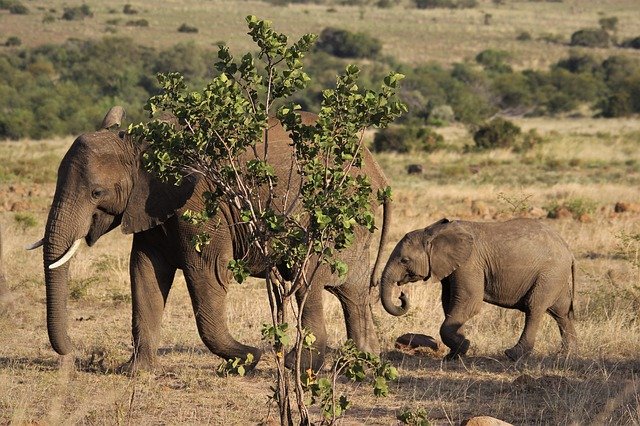
Paradigm by Nel Botha from Pixabay
-
viii. Longfin Eel
Longfin eels typically alive up to 60 years old though the longest living on tape reached 106! They are native to New Zealand and Commonwealth of australia and spend nearly of their life hiding in freshwater streams before migrating to the Pacific Ocean to breed. They only practice this in one case in the lifetime and die after spawning. They are very irksome-growing animals, growing only i-2cm a year, but females eventually grow to an impressive 73–156 cm in length.

Image by Carpenter0 (Wiki Commons User)
-
vii. Galapagos Giant Tortoise
Information technology's non merely the Galapagos Behemothic Tortoise size that'south worth noting; information technology's also their age. They tin can live to be well over 100, with the oldest known to be 152! The oldest is not the most famous, though. Lonesome George was the last remaining Pinta Island Tortoise on the islands and, for a while, the earth'south rarest brute. He died in 2012 at effectually 100 years of age. Like many of the animals on our list, behemothic tortoises have a slow stride of life, munching on grass and other vegetation, basking in the dominicus and resting for upwardly to sixteen hours a day.
Read More about Galapagos giant tortoises.

Image: Lieutenant Elizabeth Crapo, NOAA Corps., Public domain, via Wikimedia Commons
-
6. Red Body of water Urchin
Red body of water urchins are believed to be almost immortal and are known to alive for over 200 years with no signs of ageing. They are far more likely to be eaten past a predator than die of an age-related condition, and a 100-yr-old is just as healthy and able to reproduce equally a young individual. Finding the age of these spiny echinoderms is possible by measuring the levels of carbon-14, a process known every bit radiocarbon dating.
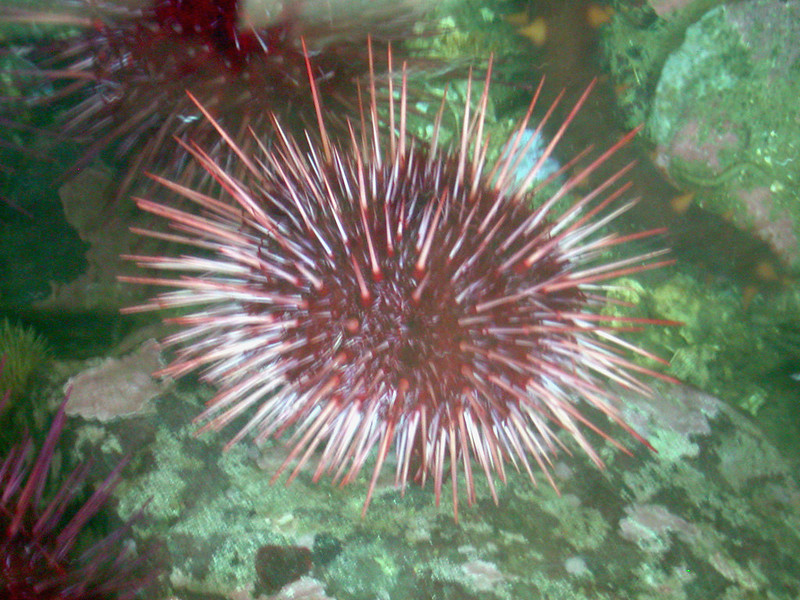
Prototype past Oregon State University from Flickr.
-
5. Koi Fish
The average lifespan for Japanese Koi is around xl years though they can live a lot longer if living in the correct conditions. One detail koi, named "Hanako", was the remarkable age of 226 when she died in 1977. Scientists were able to estimate her age past counting growth rings in her scales.

Image by Pexels from Pixabay.
-
iv. Bowhead Whale
Bowhead whales can alive for over 200 years, which is longer than any other mammal. Information technology's not always piece of cake to tell their historic period, though, as they spend their lives in the Chill and sub-Arctic and can outlive the researchers that written report them. One way to estimate age is to base it on fragments of harpoons left in the blubber of captured animals – i individual had harpoon fragments dating dorsum to the 1800s! Another way is to use Deoxyribonucleic acid to approximate lifespan, with scientists suggesting bowhead whales tin can live to the thousand onetime historic period of 268!
Read More nearly bowhead whales.

Film Credit: Bering Land Bridge national Preserve (Wiki Commons)
-
three. Greenland Shark
Greenland sharks live for between 300 and 500 years and are the longest-living vertebrate. They take life very slowly, moving at an average of 0.76 mph. They grow well-nigh a cm every year, and females may not reach sexual maturity until they are 100 to 150 years quondam – that'south ane long childhood! Despite their huge size and long lifespan though, these sharks have been a mystery to scientists for years. It was merely recently that they discovered a new method of estimating historic period that involves radiocarbon dating the lens of the eye. New tissues are added to the lens every year and it is possible to tell the age by how much carbon isotope is present in the tissues.

Photo credit: NOAA Okeanos Explorer Program
-
2. Bounding main Quahog
Ocean Quahogs are an edible clam with an impressive lifespan. Many will live to run across their 400th birthday and the oldest one on tape was 507 years erstwhile when it was caught off the declension of Iceland in 2006. Scientists were able to determine the age by counting growth rings on the shell, similar to how we age trees. They can too detect out other information as well. How the shells course over time tells scientists how the oceans have changed throughout the years – they are a living beast and a picture of life in a changing world!

Photo credit: NOAA Photo Library
-
1. Immortal Jellyfish
Can y'all imagine existence immortal? Reaching old historic period and then instead of dying, going back and starting again as a baby? To the states, this is the stuff of dreams. For the immortal jellyfish, it is real life. These amazing animals get-go their life as larvae, known as planula, swirling around in the ocean. They and then settle on the seafloor and become static polyps before transforming into swimming medusa. So far, then normal. But, if at whatsoever phase immortal jellyfish experience injury or stress from changes in their environment, they can go backwards to the polyp stage and start again. And they can do this over and over if they get the gamble. Many won't though as they go dinner for other animals.
Read More nearly jellyfish in our Animal A-Z
Image: Bachware, CC Past-SA 4.0
Source: https://onekindplanet.org/top-10/top-10-worlds-longest-living-animals/

Post a Comment for "How Long Can a Dog Live With Aspergillus"