what conclusion did george cuvier come to after his inspection of the fossil record?
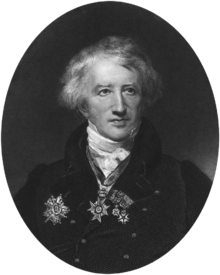
| The Baron Cuvier ForMemRS | |
|---|---|
 | |
| Born | Jean Léopold Nicolas Frédéric Cuvier (1769-08-23)23 August 1769 Montbéliard, County of Montbéliard, Duchy of Württemberg, Holy Roman Empire |
| Died | thirteen May 1832(1832-05-thirteen) (aged 62) Paris, Kingdom of France |
| Nationality | French |
| Other names | Georges Cuvier |
| Known for | Le Règne Animal; establishing the fields of stratigraphy and comparative anatomy, and the principle of faunal succession in the fossil record; making extinction an accepted scientific phenomenon; opposing theories of development; popularizing catastrophism |
| Scientific career | |
| Fields | Natural history, paleontology, anatomy |
| Institutions | Muséum national d'histoire naturelle |
| Author abbrev. (phytology) | Cuvier |
Jean Léopold Nicolas Frédéric, Baron Cuvier (French: [kyvje]; 23 August 1769 – 13 May 1832), known as Georges Cuvier, was a French naturalist and zoologist, sometimes referred to as the "founding begetter of paleontology".[one] Cuvier was a major effigy in natural sciences enquiry in the early 19th century and was instrumental in establishing the fields of comparative beefcake and paleontology through his work in comparing living animals with fossils.
Cuvier's work is considered the foundation of vertebrate paleontology, and he expanded Linnaean taxonomy past group classes into phyla and incorporating both fossils and living species into the nomenclature.[2] Cuvier is besides known for establishing extinction as a fact—at the time, extinction was considered by many of Cuvier's contemporaries to exist merely controversial speculation. In his Essay on the Theory of the World (1813) Cuvier proposed that now-extinct species had been wiped out by periodic catastrophic flooding events. In this mode, Cuvier became the nearly influential proponent of catastrophism in geology in the early 19th century.[3] His study of the strata of the Paris basin with Alexandre Brongniart established the bones principles of biostratigraphy.[4]
Among his other accomplishments, Cuvier established that elephant-similar bones found in North America belonged to an extinct animal he later would name equally a mastodon, and that a large skeleton dug up in nowadays-day Argentina was of Megatherium, a giant, prehistoric footing sloth. He named the pterosaur Pterodactylus, described (but did not observe or name) the aquatic reptile Mosasaurus, and was one of the first people to suggest the earth had been dominated by reptiles, rather than mammals, in prehistoric times.
Cuvier is also remembered for strongly opposing theories of evolution, which at the time (earlier Darwin's theory) were mainly proposed by Jean-Baptiste de Lamarck and Geoffroy Saint-Hilaire. Cuvier believed there was no evidence for evolution, but rather bear witness for cyclical creations and destructions of life forms by global extinction events such as deluges. In 1830, Cuvier and Geoffroy engaged in a famous debate, which is said to exemplify the ii major deviations in biological thinking at the fourth dimension – whether beast construction was due to function or (evolutionary) morphology.[five] Cuvier supported function and rejected Lamarck'due south thinking.
Cuvier also conducted racial studies which provided function of the foundation for scientific racism, and published piece of work on the supposed differences between racial groups' physical properties and mental abilities.[6] Cuvier subjected Sarah Baartman to examinations alongside other French naturalists during a menstruum in which she was held captive in a state of neglect. Cuvier examined Baartman presently before her expiry, and conducted an autopsy following her expiry that disparagingly compared her concrete features to those of monkeys.[7]
Cuvier's most famous piece of work is Le Règne Brute (1817; English: The Fauna Kingdom). In 1819, he was created a peer for life in honor of his scientific contributions.[viii] Thereafter, he was known equally Baron Cuvier. He died in Paris during an epidemic of cholera. Some of Cuvier'southward most influential followers were Louis Agassiz on the continent and in the Usa, and Richard Owen in U.k.. His name is one of the 72 names inscribed on the Eiffel Tower.
Biography [edit]

Jean Léopold Nicolas Frédéric Cuvier was born in Montbéliard, where his Protestant ancestors had lived since the time of the Reformation.[9] His mother was Anne Clémence Chatel; his father, Jean George Cuvier, was a lieutenant in the Swiss Guards and a conservative of the town of Montbéliard.[10] At the time, the boondocks, which was annexed to France on ten October 1793, belonged to the Duchy of Württemberg. His female parent, who was much younger than his father, tutored him diligently throughout his early years, so he easily surpassed the other children at school.[nine] During his gymnasium years, he had little trouble acquiring Latin and Greek, and was ever at the head of his class in mathematics, history, and geography.[11] According to Lee,[eleven] "The history of mankind was, from the earliest menstruation of his life, a subject area of the most indefatigable application; and long lists of sovereigns, princes, and the driest chronological facts, one time arranged in his retentiveness, were never forgotten."
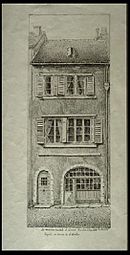
At the historic period of 10, soon after inbound the gymnasium, he encountered a copy of Conrad Gessner's Historiae Animalium, the work that first sparked his involvement in natural history. He then began frequent visits to the dwelling of a relative, where he could borrow volumes of the Comte de Buffon's massive Histoire Naturelle. All of these he read and reread, retaining so much of the information, that by the age of 12, "he was as familiar with quadrupeds and birds as a starting time-rate naturalist."[11] He remained at the gymnasium for four years.
Cuvier spent an additional four years at the Caroline Academy in Stuttgart, where he excelled in all of his coursework. Although he knew no German on his arrival, after simply nine months of study, he managed to win the school prize for that linguistic communication. Cuvier's German education exposed him to the piece of work of the geologist Abraham Gottlob Werner (1750 - 1817), whose Neptunism and emphasis on the importance of rigorous, direct observation of three-dimensional, structural relationships of rock formations to geological understanding provided models for Cuvier's scientific theories and methods.[thirteen]
Upon graduation, he had no coin on which to live equally he awaited appointment to an bookish part. So in July 1788, he took a job at Fiquainville chateau in Normandy as tutor to the but son of the Comte d'Héricy, a Protestant noble. There, during the early 1790s, he began his comparisons of fossils with extant forms. Cuvier regularly attended meetings held at the nearby boondocks of Valmont for the discussion of agricultural topics. In that location, he became acquainted with Henri Alexandre Tessier (1741–1837), who had assumed a imitation identity. Previously, he had been a physician and well-known agronomist, who had fled the Terror in Paris. Subsequently hearing Tessier speak on agricultural matters, Cuvier recognized him equally the writer of certain articles on agriculture in the Encyclopédie Méthodique and addressed him as M. Tessier.
Tessier replied in dismay, "I am known, then, and consequently lost."—"Lost!" replied M. Cuvier, "no; you are henceforth the object of our well-nigh anxious care."[14] They shortly became intimate and Tessier introduced Cuvier to his colleagues in Paris—"I have just establish a pearl in the dunghill of Normandy", he wrote his friend Antoine-Augustin Parmentier.[xv] As a result, Cuvier entered into correspondence with several leading naturalists of the day, and was invited to Paris. Arriving in the spring of 1795, at the age of 26, he soon became the assistant of Jean-Claude Mertrud (1728–1802), who had been appointed to the chair of Creature Anatomy at the Jardin des Plantes. When Mertrud died in 1802, Cuvier replaced him in office and the Chair changed its name to Chair of Comparative Anatomy.[16]
The Institut de France was founded in the same year, and he was elected a member of its Academy of Sciences. On 4 April 1796 he began to lecture at the École Centrale du Pantheon and, at the opening of the National Found in April, he read his first paleontological newspaper, which subsequently was published in 1800 under the title Mémoires sur les espèces d'éléphants vivants et fossiles. In this paper, he analyzed skeletal remains of Indian and African elephants, as well as mammoth fossils, and a fossil skeleton known at that time as the 'Ohio animal'.
Cuvier's assay established, for the first time, the fact that African and Indian elephants were different species and that mammoths were not the aforementioned species as either African or Indian elephants, so must exist extinct. He further stated that the 'Ohio animal' represented a distinct and extinct species that was even more than dissimilar from living elephants than mammoths were. Years later, in 1806, he would return to the 'Ohio fauna' in some other paper and give it the name, "mastodon".
In his 2d paper in 1796, he described and analyzed a big skeleton constitute in Paraguay, which he would name Megatherium. He concluded this skeleton represented yet another extinct animal and, past comparing its skull with living species of tree-dwelling sloths, that it was a kind of ground-dwelling giant sloth.
Together, these two 1796 papers were a seminal or landmark event, becoming a turning point in the history of paleontology, and in the evolution of comparative beefcake, as well. They also greatly enhanced Cuvier's personal reputation and they essentially concluded what had been a long-running contend well-nigh the reality of extinction.
In 1799, he succeeded Daubenton equally professor of natural history in the Collège de France. In 1802, he became titular professor at the Jardin des Plantes; and in the aforementioned year, he was appointed commissary of the plant to accompany the inspectors full general of public instruction. In this latter capacity, he visited the southward of France, but in the early office of 1803, he was chosen permanent secretary of the department of physical sciences of the University, and he consequently abandoned the earlier appointment and returned to Paris. In 1806, he became a foreign fellow member of the Imperial Society, and in 1812, a strange member of the Purple Swedish Academy of Sciences. In 1812 he became a correspondent for the Royal Institute of the Netherlands, and became member in 1827.[17] Cuvier was elected a Strange Honorary Member of the American Academy of Arts and Sciences in 1822.[18]

Cuvier and then devoted himself more especially to 3 lines of inquiry: (i) the construction and classification of the Mollusca; (ii) the comparative anatomy and systematic arrangement of the fishes; (iii) fossil mammals and reptiles and, secondarily, the osteology of living forms belonging to the same groups.
In 1812, Cuvier made what the cryptozoologist Bernard Heuvelmans called his "Rash dictum": he remarked that it was unlikely that any large animal remained undiscovered. Ten years after his death, the word "dinosaur" would exist coined past Richard Owen in 1842.
During his lifetime, Cuvier served every bit an imperial councilor under Napoleon, president of the Council of Public Educational activity and chancellor of the university under the restored Bourbons, Yard Officeholder of the Legion of Honour, a Peer of France, Minister of the Interior, and president of the Council of Country under Louis Philippe. He was eminent in all these capacities, and yet the dignity given by such loftier administrative positions was equally nothing compared to his leadership in natural scientific discipline.[19]
Cuvier was by birth, education, and conviction a devout Lutheran,[twenty] and remained Protestant throughout his life while regularly attending church services. Despite this, he regarded his personal faith every bit a individual matter; he evidently identified himself with his confessional minority group when he supervised governmental educational programs for Protestants. He as well was very agile in founding the Parisian Biblical Society in 1818, where he afterwards served as a vice president.[21] From 1822 until his death in 1832, Cuvier was K Principal of the Protestant Faculties of Theology of the French Academy.[22]
Scientific ideas and their bear on [edit]
Opposition to evolution [edit]
Cuvier was critical of theories of evolution, in particular those proposed by his contemporaries Lamarck and Geoffroy Saint-Hilaire, which involved the gradual transmutation of one form into another. He repeatedly emphasized that his extensive experience with fossil material indicated one fossil grade does not, as a dominion, gradually change into a succeeding, distinct fossil form. A deep-rooted source of his opposition to the gradual transformation of species was his goal of creating an accurate taxonomy based on principles of comparative anatomy.[23] Such a projection would get impossible if species were mutable, with no clear boundaries between them. Co-ordinate to the Academy of California Museum of Paleontology, "Cuvier did not believe in organic development, for whatsoever modify in an organism'south beefcake would accept rendered information technology unable to survive. He studied the mummified cats and ibises that Geoffroy had brought back from Napoleon'southward invasion of Arab republic of egypt, and showed they were no unlike from their living counterparts; Cuvier used this to back up his claim that life forms did not evolve over time."[24] [25]
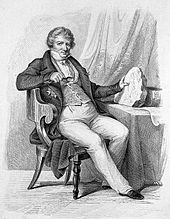
Cuvier with a fish fossil
He also observed that Napoleon'southward expedition to Arab republic of egypt had retrieved animals mummified thousands of years previously that seemed no dissimilar from their modern counterparts.[26] "Certainly", Cuvier wrote, "one cannot detect whatever greater deviation between these creatures and those we run across, than between the homo mummies and the skeletons of nowadays-day men."[27]
Lamarck dismissed this conclusion, arguing that evolution happened much too slowly to be observed over but a few thousand years. Cuvier, however, in turn criticized how Lamarck and other naturalists conveniently introduced hundreds of thousands of years "with a stroke of a pen" to uphold their theory. Instead, he argued that one may judge what a long time would produce but by multiplying what a bottom fourth dimension produces. Since a lesser fourth dimension produced no organic changes, neither, he argued, would a much longer time.[28] Moreover, his commitment to the principle of the correlation of parts caused him to doubt that any mechanism could ever gradually modify any part of an brute in isolation from all the other parts (in the manner Lamarck proposed), without rendering the animate being unable to survive.[29] In his Éloge de M. de Lamarck (Praise for Thou. de Lamarck),[30] [31] Cuvier wrote that Lamarck's theory of development
rested on ii arbitrary suppositions; the ane, that it is the seminal vapor which organizes the embryo; the other, that efforts and desires may engender organs. A system established on such foundations may amuse the imagination of a poet; a metaphysician may derive from information technology an entirely new series of systems; only it cannot for a moment bear the test of anyone who has dissected a paw, a viscus, or even a plume.[30]
Instead, he said, the typical form makes an abrupt appearance in the fossil record, and persists unchanged to the time of its extinction. Cuvier attempted to explain this paleontological miracle he envisioned (which would be readdressed more than than a century later by "punctuated equilibrium") and to harmonize it with the Bible. He attributed the unlike time periods he was aware of equally intervals betwixt major catastrophes, the last of which is found in Genesis.[32] [33]
Cuvier's claim that new fossil forms announced abruptly in the geological record and then continue without alteration in overlying strata was used by later critics of evolution to support creationism,[34] to whom the abruptness seemed consequent with special divine creation (although Cuvier'south finding that unlike types made their paleontological debuts in different geological strata clearly did not). The lack of change was consistent with the supposed sacred immutability of "species", but, again, the idea of extinction, of which Cuvier was the nifty proponent, patently was not.
Many writers take unjustly accused Cuvier of obstinately maintaining that fossil human beings could never be institute. In his Essay on the Theory of the Earth, he did say, "no human bones have withal been found amid fossil remains", simply he fabricated information technology clear exactly what he meant: "When I assert that human bones have not been hitherto found among extraneous fossils, I must exist understood to speak of fossils, or petrifactions, properly and then called".[35] Petrified bones, which accept had time to mineralize and plow to rock, are typically far older than bones found to that date. Cuvier's betoken was that all human bones plant that he knew of, were of relatively recent age because they had not been petrified and had been constitute merely in superficial strata.[36] He was not dogmatic in this merits, however; when new evidence came to light, he included in a later edition an appendix describing a skeleton that he freely admitted was an "example of a fossil human petrifaction".[37]
The harshness of his criticism and the strength of his reputation, however, continued to discourage naturalists from speculating near the gradual transmutation of species, until Charles Darwin published On the Origin of Species more two decades later Cuvier's death.[38]
Extinction [edit]
Early in his tenure at the National Museum in Paris, Cuvier published studies of fossil basic in which he argued that they belonged to large, extinct quadrupeds. His offset ii such publications were those identifying mammoth and mastodon fossils as belonging to extinct species rather than modern elephants and the report in which he identified the Megatherium as a giant, extinct species of sloth.[39] His primary evidence for his identifications of mammoths and mastodons as carve up, extinct species was the structure of their jaws and teeth.[xl] His primary bear witness that the Megatherium fossil had belonged to a massive sloth came from his comparison of its skull with those of extant sloth species.[41]
Cuvier wrote of his paleontological method that "the form of the tooth leads to the form of the condyle, that of the scapula to that of the nails, just as an equation of a curve implies all of its properties; and, simply every bit in taking each property separately as the basis of a special equation we are able to render to the original equation and other associated properties, similarly, the nails, the scapula, the condyle, the femur, each separately revel the tooth or each other; and by offset from each of them the thoughtful professor of the laws of organic economic system can reconstruct the entire animal."[42] Still, Cuvier'due south actual method was heavily dependent on the comparison of fossil specimens with the beefcake of extant species in the necessary context of his vast noesis of animate being beefcake and admission to unparallelled natural history collections in Paris.[43] This reality, however, did not prevent the rise of a popular legend that Cuvier could reconstruct the entire bodily structures of extinct animals given only a few fragments of bone.[44]
At the time Cuvier presented his 1796 paper on living and fossil elephants, it was still widely believed that no species of animal had ever become extinct. Government such as Buffon had claimed that fossils constitute in Europe of animals such as the woolly rhino and the mammoth were remains of animals still living in the tropics (i.e. rhinoceros and elephants), which had shifted out of Europe and Asia as the earth became cooler.
Thereafter, Cuvier performed a pioneering enquiry study on some elephant fossils excavated around Paris. The bones he studied, however, were remarkably different from the bones of elephants currently thriving in India and Africa. This discovery led Cuvier to denounce the idea that fossils came from those that are currently living. The idea that these bones belonged to elephants living – but hiding – somewhere on Earth seemed ridiculous to Cuvier, considering it would be virtually impossible to miss them due to their enormous size. The Megatherium provided another compelling datapoint for this argument. Ultimately, his repeated identification of fossils as belonging to species unknown to man, combined with mineralogical testify from his stratigraphical studies in Paris, drove Cuvier to the proposition that the precipitous changes the Earth underwent over a long period of time caused some species to go extinct.[45]
Cuvier'southward theory on extinction has met opposition from other notable natural scientists like Darwin and Charles Lyell. Dissimilar Cuvier, they didn't believe that extinction was a sudden process; they believed that like the World, animals collectively undergo gradual change as a species. This differed widely from Cuvier's theory, which seemed to propose that animate being extinction was catastrophic.
However, Cuvier's theory of extinction is still justified in the case of mass extinctions that occurred in the final 600 1000000 years, when approximately half of all living species went completely extinct within a brusk geological span of two million years, due in function by volcanic eruptions, asteroids, and rapid fluctuations in sea level. At this time, new species rose and others vicious, precipitating the arrival of human beings.
Cuvier'due south early on work demonstrated conclusively that extinction was indeed a credible natural global procedure.[46] Cuvier's thinking on extinctions was influenced by his extensive readings in Greek and Latin literature; he gathered every aboriginal written report known in his day relating to discoveries of petrified basic of remarkable size in the Mediterranean region.[47]
Influence on Cuvier'south theory of extinction was his collection of specimens from the New World, many of them obtained from Native Americans. He also maintained an archive of Native American observations, legends, and interpretations of immense fossilized skeletal remains, sent to him by informants and friends in the Americas. He was impressed that about of the Native American accounts identified the enormous bones, teeth, and tusks as animals of the deep past that had been destroyed by ending.[48]
Catastrophism [edit]

These Indian elephant and mammoth jaws were included in 1799 when Cuvier's 1796 newspaper on living and fossil elephants was printed.
Cuvier came to believe that nearly, if not all, the animal fossils he examined were remains of species that had become extinct. About the end of his 1796 paper on living and fossil elephants, he said:
- All of these facts, consistent among themselves, and not opposed by any written report, seem to me to prove the existence of a world previous to ours, destroyed by some kind of ending.
Contrary to many natural scientists' beliefs at the time, Cuvier believed that fauna extinction was not a product of anthropogenic causes. Instead, he proposed that humans were around long enough to indirectly maintain the fossilized records of ancient Globe. He also attempted to verify the h2o catastrophe by analyzing records of various cultural backgrounds. Though he institute many accounts of the water ending unclear, he did believe that such an upshot occurred at the brink of man history even so.
This led Cuvier to become an active proponent of the geological school of thought called catastrophism, which maintained that many of the geological features of the world and the history of life could be explained by catastrophic events that had caused the extinction of many species of animals. Over the grade of his career, Cuvier came to believe in that location had not been a single catastrophe, just several, resulting in a succession of different faunas. He wrote about these ideas many times, in item he discussed them in great item in the preliminary discourse (an introduction) to a drove of his papers, Recherches sur les ossements fossiles de quadrupèdes (Researches on quadruped fossil bones), on quadruped fossils published in 1812.
Cuvier'due south own explanation for such a catastrophic issue is derived from two unlike sources, including those from Jean-André Deluc and Déodat de Dolomieu. The erstwhile proposed that the continents existing 10 millennia ago collapsed, allowing the ocean floors to rise higher than the continental plates and get the continents that now be today. The latter proposed that a massive tsunami hit the earth, leading to mass extinction. Whatever the case was, he believed that the drench happened quite recently in human history. In fact, he believed that Globe'southward existence was limited and not equally extended as many natural scientists, like Lamarck, believed it to be.
Much of the show he used to support his catastrophist theories take been taken from his fossil records. He strongly suggested that the fossils he establish were evidence of the world's first reptiles, followed chronologically by mammals and humans. Cuvier didn't wish to delve much into the causation of all the extinction and introduction of new beast species just rather focused on the sequential aspects of animal history on Earth. In a way, his chronological dating of Earth history somewhat reflected Lamarck's transformationist theories.
Cuvier also worked aslope Alexandre Brongniart in analyzing the Parisian rock cycle. Using stratigraphical methods, they were both able to extrapolate key information regarding Earth history from studying these rocks. These rocks contained remnants of mollusks, bones of mammals, and shells. From these findings, Cuvier and Brongniart concluded that many ecology changes occurred in quick catastrophes, though World itself was oftentimes placid for extended periods of time in between sudden disturbances.
The 'Preliminary Discourse' became very well known and, unauthorized translations were made into English, German, and Italian (and in the case of those in English language, non entirely accurately). In 1826, Cuvier would publish a revised version under the name, Discours sur les révolutions de la surface du globe (Discourse on the upheavals of the surface of the earth).[49]
Afterwards Cuvier's decease, the catastrophic school of geological thought lost ground to uniformitarianism, equally championed by Charles Lyell and others, which claimed that the geological features of the world were best explained by currently observable forces, such every bit erosion and volcanism, interim gradually over an extended period of time. The increasing interest in the topic of mass extinction starting in the belatedly twentieth century, even so, has led to a resurgence of involvement among historians of science and other scholars in this aspect of Cuvier'southward work.[50]
Stratigraphy [edit]
Cuvier collaborated for several years with Alexandre Brongniart, an instructor at the Paris mining school, to produce a monograph on the geology of the region effectually Paris. They published a preliminary version in 1808 and the final version was published in 1811.
In this monograph they identified characteristic fossils of unlike rock layers that they used to analyze the geological column, the ordered layers of sedimentary rock, of the Paris basin. They concluded that the layers had been laid down over an extended period during which there clearly had been faunal succession and that the area had been submerged nether sea h2o at times and at other times under fresh water. Along with William Smith'south work during the aforementioned period on a geological map of England, which besides used feature fossils and the principle of faunal succession to correlate layers of sedimentary rock, the monograph helped plant the scientific discipline of stratigraphy. It was a major development in the history of paleontology and the history of geology.[51]
Age of reptiles [edit]
In 1800 and working just from a drawing, Cuvier was the commencement to correctly identify in print, a fossil found in Bavaria every bit a modest flight reptile,[52] which he named the Ptero-Dactyle in 1809,[53] (subsequently Latinized every bit Pterodactylus antiquus)—the outset known member of the various club of pterosaurs. In 1808 Cuvier identified a fossil found in Maastricht as a giant marine cadger, the outset known mosasaur.
Cuvier speculated correctly that there had been a time when reptiles rather than mammals had been the dominant animal.[54] This speculation was confirmed over the two decades post-obit his death by a series of spectacular finds, mostly by English language geologists and fossil collectors such as Mary Anning, William Conybeare, William Buckland, and Gideon Mantell, who plant and described the first ichthyosaurs, plesiosaurs, and dinosaurs.
Principle of the correlation of parts [edit]
In a 1798 paper on the fossil remains of an animal plant in some plaster quarries nigh Paris, Cuvier states what is known as the principle of the correlation of parts. He writes:[55]
- If an animal's teeth are such as they must be, in order for it to nourish itself with flesh, we tin be sure without further examination that the whole organization of its digestive organs is appropriate for that kind of food, and that its whole skeleton and locomotive organs, and even its sense organs, are arranged in such a way equally to make it skillful at pursuing and catching its prey. For these relations are the necessary weather condition of being of the animal; if things were not so, it would not be able to subsist.
This idea is referred to as Cuvier'south principle of correlation of parts, which states that all organs in an animal's body are securely interdependent. Species' being relies on the style in which these organs interact. For instance, a species whose digestive tract is best suited to digesting mankind but whose trunk is best suited to foraging for plants cannot survive. Thus in all species, the functional significance of each body role must be correlated to the others, else the species cannot sustain itself.[56]
Applications [edit]
Cuvier believed that the ability of his principle came in part from its power to aid in the reconstruction of fossils. In most cases, fossils of quadrupeds were non found as consummate, assembled skeletons, just rather as scattered pieces that needed to be put together by anatomists. To make matters worse, deposits often contained the fossilized remains of several species of animals mixed together. Anatomists reassembling these skeletons ran the take a chance of combining remains of unlike species, producing imaginary blended species. All the same, by examining the functional purpose of each bone and applying the principle of correlation of parts, Cuvier believed that this problem could be avoided.
This principle'southward power to assist in reconstruction of fossils was also helpful to Cuvier's piece of work in providing evidence in favor extinction. The strongest evidence Cuvier could provide in favor of extinction would be to evidence that the fossilized remains of an fauna belonged to a species that no longer existed. Past applying Cuvier'due south principle of correlation of parts, it would be easier to verify that a fossilized skeleton had been authentically reconstructed, thus validating any observations drawn from comparing it to skeletons of existing species.
In addition to helping anatomists reconstruct fossilized remains, Cuvier believed that his principle held enormous predictive power equally well. For example, when he discovered a fossil that resembled a marsupial in the gypsum quarries of Montmartre, he correctly predicted that the fossil would contain bones usually plant in marsupials in its pelvis every bit well.[56]
Touch [edit]
Cuvier hoped that his principles of anatomy would provide the police-based framework that would elevate natural history to the truly scientific level occupied by physics and chemistry thanks to the laws established past Isaac Newton (1643 - 1727) and Antoine Lavoisier (1743 - 1794), respectively. He expressed confidence in the introduction to Le Règne Animal that some solar day anatomy would exist expressed as laws equally simple, mathematical, and predictive as Newton's laws of physics, and he viewed his principle every bit an important step in that direction.[57] To him, the predictive capabilities of his principles demonstrated in his prediction of the existence of marsupial pelvic basic in the gypsum quarries of Montmartre demonstrated that these goals were not only in reach, simply imminent.[58]
The principle of correlation of parts was also Cuvier'due south way of agreement role in a not-evolutionary context, without invoking a divine creator.[59] In the same 1798 paper on the fossil remains of an creature found in plaster quarries near Paris, Cuvier emphasizes the predictive power of his principle, writing,[55]
Today comparative beefcake has reached such a betoken of perfection that, after inspecting a single bone, i can ofttimes determine the class, and sometimes even the genus of the animal to which it belonged, in a higher place all if that bone belonged to the head or the limbs ... This is because the number, direction, and shape of the basic that compose each part of an animal's body are always in a necessary relation to all the other parts, in such a mode that—upward to a point—one can infer the whole from any one of them and vice versa.
Though Cuvier believed that his principle's major contribution was that it was a rational, mathematical way to reconstruct fossils and make predictions, in reality information technology was difficult for Cuvier to use his principle. The functional significance of many body parts were yet unknown at the fourth dimension, and then relating those body parts to other torso parts using Cuvier'southward principle was impossible. Though Cuvier was able to brand authentic predictions about fossil finds, in practice the accurateness of his predictions came non from application of his principle, merely rather from his vast knowledge of comparative anatomy. However, despite Cuvier's exaggerations of the power of his principle, the basic concept is central to comparative beefcake and paleontology.[56]
Scientific work [edit]
Comparative anatomy and classification [edit]
At the Paris Museum, Cuvier furthered his studies on the anatomical classification of animals. He believed that classification should exist based on how organs collectively role, a concept he called functional integration. Cuvier reinforced the thought of subordinating less vital body parts to more disquisitional organ systems as part of anatomical nomenclature. He included these ideas in his 1817 book, The Animal Kingdom.
In his anatomical studies, Cuvier believed role played a bigger role than form in the field of taxonomy. His scientific beliefs rested in the thought of the principles of the correlation of parts and of the conditions of existence. The old principle accounts for the connectedness betwixt organ role and its applied use for an organism to survive. The latter principle emphasizes the animal's physiological part in relation to its surrounding environment. These findings were published in his scientific readings, including Leçons d'anatomie comparée (Lessons on Comparative Anatomy) between 1800 and 1805,[a] and The Animal Kingdom in 1817.
Ultimately, Cuvier adult four embranchements, or branches, through which he classified animals based on his taxonomical and anatomical studies. He later performed groundbreaking work in classifying animals in vertebrate and invertebrate groups past subdividing each category. For instance, he proposed that the invertebrates could be segmented into iii private categories, including Mollusca, Radiata, and Articulata. He also articulated that species cannot motility across these categories, a theory called transmutation. He reasoned that organisms cannot learn or change their concrete traits over fourth dimension and still retain optimal survival. As a event, he often conflicted with Geoffroy Saint-Hilaire and Jean-Baptiste Lamarck'south theories of transmutation.
In 1798, Cuvier published his start independent piece of work, the Tableau élémentaire de l'histoire naturelle des animaux, which was an abridgment of his course of lectures at the École du Pantheon and may exist regarded as the foundation and first argument of his natural classification of the animal kingdom.
Mollusks [edit]
Cuvier categorized snails, cockles, and cuttlefish into one category he called molluscs (Mollusca), an embranchment. Though he noted how all iii of these animals were outwardly different in terms of shell shape and diet, he saw a noticeable pattern pertaining to their overall physical advent.
Cuvier began his intensive studies of molluscs during his time in Normandy – the outset time he had e'er seen the sea – and his papers on the so-chosen Mollusca began actualization as early on as 1792.[60] However, most of his memoirs on this co-operative were published in the Annales du museum between 1802 and 1815; they were subsequently collected as Mémoires pour servir à l'histoire et à fifty'anatomie des mollusques, published in i volume at Paris in 1817.
Fish [edit]
Cuvier's researches on fish, begun in 1801, finally culminated in the publication of the Histoire naturelle des poissons, which contained descriptions of 5,000 species of fishes, and was a articulation product with Achille Valenciennes. Cuvier's work on this projection extended over the years 1828–1831.
Palaeontology and osteology [edit]

Plate from Le Règne Animal, 1828 edition
In palaeontology, Cuvier published a long list of memoirs, partly relating to the bones of extinct animals, and partly detailing the results of observations on the skeletons of living animals, specially examined with a view toward throwing light upon the construction and affinities of the fossil forms.
Among living forms he published papers relating to the osteology of the Rhinoceros Indicus, the tapir, Hyrax capensis, the hippopotamus, the sloths, the manatee, etc.
He produced an even larger body of work on fossils, dealing with the extinct mammals of the Eocene beds of Montmartre and other localities most Paris, such as the Buttes Chaumont,[61] the fossil species of hippopotamus, Palaeotherium, a marsupial (which he called Didelphys gypsorum), the Megalonyx, the Megatherium, the cave-hyena, the pterodactyl, the extinct species of rhino, the cave bear, the mastodon, the extinct species of elephant, fossil species of manatee and seals, fossil forms of crocodilians, chelonians, fish, birds, etc. If his identification of fossil animals was dependent upon comparison with the osteology of extant animals whose anatomy was poorly known, Cuvier would often publish a thorough documentation of the relevant extant species' anatomy before publishing his analyses of the fossil specimens.[62] The department of palaeontology dealing with the Mammalia may exist said to have been substantially created and established by Cuvier.
The results of Cuvier's principal palaeontological and geological investigations ultimately were given to the earth in the form of two split works: Recherches sur les ossemens fossiles de quadrupèdes (Paris, 1812; afterwards editions in 1821 and 1825); and Discours sur les revolutions de la surface du globe (Paris, 1825). In this latter work he expounded a scientific theory of Catastrophism.
The Beast Kingdom (Le Règne Animate being) [edit]

Plate from Le Règne Brute, 1828 edition
Cuvier's most admired work was his Le Règne Animal. It appeared in 4 octavo volumes in 1817; a 2d edition in five volumes was brought out in 1829–1830. In this classic piece of work, Cuvier presented the results of his life's enquiry into the construction of living and fossil animals. With the exception of the section on insects, in which he was assisted past his friend Latreille, the whole of the work was his ain. It was translated into English language many times, frequently with substantial notes and supplementary fabric updating the book in accordance with the expansion of knowledge.
Racial studies [edit]
Cuvier was a Protestant and a believer in monogenism, who held that all men descended from the biblical Adam, although his position usually was confused as polygenist. Some writers who accept studied his racial work have dubbed his position as "quasi-polygenist", and most of his racial studies have influenced scientific racism. Cuvier believed at that place were three singled-out races: the Caucasian (white), Mongolian (yellowish), and the Ethiopian (black). Cuvier claimed that Adam and Eve were Caucasian, the original race of flesh. The other two races originated by survivors escaping in different directions after a major ending hit the earth 5,000 years agone, with those survivors then living in consummate isolation from each other.[6] [63]
Cuvier categorized these divisions he identified into races according to his perception of the beauty or ugliness of their skulls and the quality of their civilizations. Cuvier's racial studies held the supposed features of polygenism, namely fixity of species; limits on environmental influence; unchanging underlying blazon; anatomical and cranial measurement differences in races; concrete and mental differences between distinct races.[6]
Sarah Baartman [edit]
Alongside other French naturalists, Cuvier subjected Sarah Baartman, a Southward African Khokhoi woman exhibited in European freak shows every bit the "Hottentot Venus", to examinations. At the fourth dimension that Cuvier interacted with Baartman, Baartman's "existence was really quite miserable and extraordinarily poor. Sara was literally [sic] treated similar an animal."[64] In 1815, while Baartman was very ill, Cuvier deputed a nude painting of her. She died shortly later, aged 26.[65]
Post-obit Baartman'south death, Cuvier sought out and received permission to dissect her body, focusing on her genitalia, buttocks and skull shape. In his test, Cuvier concluded that many of Baartman's features more closely resembled the anatomy of a monkey than a human.[seven] Her remains were displayed in the Musée de fifty'Homme in Paris until 1970, then were put into storage.[66] Her remains were returned to Southward Africa in 2002.[67]
Official and public work [edit]

Apart from his ain original investigations in zoology and paleontology Cuvier carried out a vast corporeality of work as perpetual secretary of the National Found, and every bit an official connected with public education generally; and much of this work appeared ultimately in a published grade. Thus, in 1808 he was placed past Napoleon upon the council of the Majestic Academy, and in this chapters he presided (in the years 1809, 1811, and 1813) over commissions charged to examine the state of the higher educational establishments in the districts beyond the Alps and the Rhine that had been annexed to France, and to study upon the ways past which these could be affiliated with the central university. He published three separate reports on this subject.
In his capacity, over again, of perpetual secretary of the Plant, he non only prepared a number of éloges historiques on deceased members of the University of Sciences, simply was also the writer of a number of reports on the history of the physical and natural sciences, the most important of these beingness the Rapport historique sur le progrès des sciences physiques depuis 1789, published in 1810.
Prior to the autumn of Napoleon (1814) he had been admitted to the council of state, and his position remained unaffected past the restoration of the Bourbons. He was elected chancellor of the university, in which capacity he acted as interim president of the quango of public education, whilst he besides, equally a Lutheran, superintended the faculty of Protestant theology. In 1819 he was appointed president of the committee of the interior, an office he retained until his death.
In 1826 he was made g officer of the Legion of Honour; he later on was appointed president of the quango of state. He served as a member of the Académie des Inscriptions et Belles-Lettres from 1830 to his decease. A fellow member of the Doctrinaires, he was nominated to the ministry building of the interior in the beginning of 1832.
Commemorations [edit]

Cuvier is commemorated in the naming of several animals; they include Cuvier's beaked whale (which he showtime thought to be extinct), Cuvier'due south gazelle, Cuvier's toucan, Cuvier'southward bichir, Cuvier'southward dwarf caiman, and Galeocerdo cuvier (tiger shark). Cuvier is commemorated in the scientific name of the following reptiles: Anolis cuvieri (a lizard from Puerto Rico), Bachia cuvieri, and Oplurus cuvieri.[68]
The fish Hepsetus cuvieri , sometimes known as the African superhighway or Kafue superhighway characin, which is a predatory freshwater fish found in southern Africa was named later on him.[69]
In that location also are some extinct animals named after Cuvier, such equally the South American giant sloth Catonyx cuvieri.
Cuvier Island in New Zealand was named later Cuvier past D'Urville.[lxx]
The professor of English Wayne Glausser argues at length that the Aubrey-Maturin series of 21 novels (1970–2004) by Patrick O'Brian make the character Stephen Maturin "an advocate of the neo-classical epitome articulated .. by Georges Cuvier."[71]
Cuvier is referenced in Edgar Allan Poe'southward brusk story The Murders in the Rue Morgue as having written a description of the orangutan. Arthur Conan Doyle also refers to Cuvier in The Five Orange Pips, in which Sherlock Holmes compares Cuvier's methods to his own.
Works [edit]

Tableau élémentaire de l'histoire naturelle des animaux, 1797
- Tableau élémentaire de l'histoire naturelle des animaux (1797–1798)
- Leçons d'anatomie comparée (v volumes, 1800–1805)
- Essais sur la géographie minéralogique des surround de Paris, avec une carte géognostique et des coupes de terrain, with Alexandre Brongniart (1811)
- Le Règne animal distribué d'après son organisation, pour servir de base à l'histoire naturelle des animaux et d'introduction à l'anatomie comparée (4 volumes, 1817)
- Recherches sur les ossemens fossiles de quadrupèdes, où l'on rétablit les caractères de plusieurs espèces d'animaux que les révolutions du earth paroissent avoir détruites (iv volumes, 1812) (text in French) 2 3 4
- Mémoires pour servir à 50'histoire et à fifty'anatomie des mollusques (1817)
- Éloges historiques des membres de l'Académie royale des sciences, lus dans les séances de l'Institut royal de French republic par M. Cuvier (iii volumes, 1819–1827) Vol. ane, Vol. ii, and Vol. iii
- Théorie de la terre (1821)
-
- --- Essay on the theory of the globe, 1813; 1815, trans. Robert Kerr.
- Recherches sur les ossemens fossiles, 1821–1823 (five vols).
- Discours sur les révolutions de la surface du world et sur les changements qu'elles ont produits dans le règne animal (1822). New edition: Christian Bourgeois, Paris, 1985. (text in French)
- Histoire des progrès des sciences naturelles depuis 1789 jusqu'à ce jour (5 volumes, 1826–1836)
- Histoire naturelle des poissons (11 volumes, 1828–1848), continued past Achille Valenciennes
- Histoire des sciences naturelles depuis leur origine jusqu'à nos jours, chez tous les peuples connus, professée au Collège de France (5 volumes, 1841–1845), edited, annotated, and published by Magdeleine de Saint-Agit
- Cuvier'southward History of the Natural Sciences: twenty-four lessons from Antiquity to the Renaissance [edited and annotated by Theodore W. Pietsch, translated by Abby S. Simpson, foreword by Philippe Taquet], Paris: Publications scientifiques du Muséum national d'Histoire naturelle, 2012, 734 p. (coll. Archives; xvi) ISBN 978-2-85653-684-one
- Variorum of the works of Georges Cuvier: Preliminary Discourse of the Recherches sur les ossemens fossiles 1812, containing the Memory on the ibis of the aboriginal Egyptians, and the Discours sur les révolutions de la surface du Earth 1825, containing the Determination of the birds called ibis by the ancient Egyptians [72]
Cuvier likewise collaborated on the Dictionnaire des sciences naturelles (61 volumes, 1816–1845) and on the Biographie universelle (45 volumes, 1843-18??)
See also [edit]
- Saartjie Baartman, the "Hottentot Venus" whose body Cuvier examined
- Frédéric Cuvier, as well a naturalist, was Georges Cuvier's younger brother.
- History of paleontology for more than on the impact of Cuvier'due south scientific ideas
- List of works past James Pradier
References [edit]
Footnotes [edit]
- ^ Cuvier was assisted by A. M. C. Duméril for the first ii volumes and Georges Louis Duvernoy for the iii subsequently ones.
Citations [edit]
- ^ Reybrouck, David Van (2012). From Primitives to Primates: A History of Ethnographic and Primatological Analogies in the Report of Prehistory. Sidestone Printing. p. 54. ISBN978-ninety-8890-095-ii.
- ^ Felipe Faria (2013). "Georges Cuvier et le premier paradigme de la paléontologie" [Georges Cuvier and the first image of paleontology] (PDF). Revue de Paléobiologie (in French). 32 (two). ISSN 0253-6730.
- ^ Faria 2012, pp. 64–74
- ^ J., Bowler, Peter (2009). Evolution : the history of an idea (25th ceremony ed.). Berkeley, Calif.: University of California Printing. pp. 112–113. ISBN9780520261280. OCLC 426118505.
- ^ Appel, Toby (1987). The Cuvier-Geoffroy Debate: French Biology in the Decades Before Darwin. New York: Oxford University Press. ISBN978-0-19-504138-5.
- ^ a b c Jackson & Weidman 2005, pp. 41–42
- ^ a b Terry, Jennifer (1995). Deviant Bodies: critical perspectives on difference in science and popular culture. Bloomington, Indiana: Bloomington: Indiana Academy Printing. pp. 19–39. ISBN0253209757.
- ^ Lee 1833
- ^ a b Lee 1833, p. 8
- ^ 'Extrait du seven.east Registre des Enfants baptises dans l'Eglise françoise de Saint Martin de la Ville de Montbéliard deposé aux Archives de l'Hôtel de Ville', Culture.gouv.fr
- ^ a b c Lee 1833, p. 11
- ^ Taquet, Philippe (2006). "Les années de jeunesse de Georges Cuvier" [Georges Cuvier's early years] (PDF) (in French). Société d'émulation de Montbéliard. p. 217. Archived from the original (PDF) on 6 March 2016. Retrieved 1 July 2015.
- ^ Southward., Rudwick, M. J. (1998). Georges Cuvier, fossil bones, and geological catastrophes : new translations & interpretations of the chief texts ([Pbk. ed., 1998] ed.). Chicago, Sick.: University of Chicago Press. pp. 4, vii. ISBN978-0226731063. OCLC 45730036.
- ^ Lee 1833, p. 22
- ^ Lee 1833, p. 22, footnote
- ^ Thierry Malvésy, Georges Cuvier : Montbéliard 1769 - Paris 1832, Les Amis du Muséum national d'histoire naturelle - Publication trimestrielle (quarterly publication). Due north° 242, June 2010, ISSN 1161-9104, p. eighteen (in French)
- ^ "Georges Léopold Chrétien Frédéric Dagobert Cuvier (1769–1832)". Royal Netherlands Academy of Arts and Sciences. Retrieved xix July 2015.
- ^ "Volume of Members, 1780–2010: Chapter C" (PDF). American University of Arts and Sciences. Retrieved 8 September 2016.
- ^ Andrew Dickson White, A History of the Warfare of Scientific discipline with Theology in Christendom Appleton (1922) Vol.1 p.64
- ^ Coleman 1962, p. 16
- ^ Larson 2004, p. 8
- ^ Taquet 2006, p. 127
- ^ Coleman, William (1964). Georges Cuvier, zoologist a study in the history of evolution theory. Cambridge, Massachusetts: Harvard University Press. pp. 141–169. ISBN9780674283701. OCLC 614625731.
- ^ Waggoner 1996
- ^ Curtis, Caitlin; Millar, Craig; Lambert, David (27 September 2018). "The Sacred Ibis argue: The first test of evolution". PLOS Biological science. 16 (9): e2005558. doi:x.1371/journal.pbio.2005558. PMC6159855. PMID 30260949.
- ^ Zimmer 2006, p. xix
- ^ Rudwick 1997, p. 229
- ^ Rudwick 1997, pp. 228–229
- ^ Hall 1999, p. 62
- ^ a b "Eloge de M. de Lamarck, par le Baron Georges Cuvier" [In Praise of G. de Lamarck, by Baron Georges Cuvier]. cnrs.fr (in French). 27 June 1831. Archived from the original on 7 May 2015. Retrieved 1 July 2015.
- ^ "Cuvier's elegy of Lamarck". victorianweb.org . Retrieved 1 July 2015.
- ^ Turner 1984, p. 35
- ^ Kuznar 2008, p. 37
- ^ Gillispie 1996, p. 103
- ^ Cuvier 1818, p. 130
- ^ Cuvier 1818, pp. 133–134; English translation quoted from Cuvier 1827, p. 121
- ^ Cuvier 1827, p. 407
- ^ Larson 2004, pp. 9–10
- ^ Chandler., Smith, Jean (1993). Georges Cuvier : an annotated bibliography of his published works . Washington: Smithsonian Institution Press. ISBN978-1560981992. OCLC 25367530.
- ^ Cuvier, Georges (1998) [1796]. "Memoir on the Species of Elephants, Both Living and Fossil". Fossil Bones, and Geological Catastrophes. doi:ten.7208/chicago/9780226731087.001.0001. ISBN9780226731070.
- ^ Cuvier, Georges (1796). "Note on the skeleton of a very large species of quadruped, hitherto unknown, found in Paraguay and deposited in the Cabinet of Natural History in Madrid". Magasin Encyclopédique.
- ^ Georges Cuvier, Robert Jameson (1818). Essay on the Theory of the Earth. University of California. Kirk & Mercein. pp. 98–99.
- ^ Coleman, William (1964). Georges Cuvier, zoologist a study in the history of evolution theory. Cambridge, Massachusetts: Harvard University Press. pp. 119–122. ISBN9780674283701. OCLC 614625731.
- ^ Gowan, Dawson (21 April 2016). Prove me the bone : reconstructing prehistoric monsters in nineteenth-century Uk and America. Chicago. ISBN9780226332734. OCLC 913164287.
- ^ Georges Cuvier, Robert Jameson (1818). Essay on the Theory of the Earth. Academy of California. Kirk & Mercein.
- ^ Rudwick 1997, pp. 22–24
- ^ Mayor 2011, pp. 6, 8, 202–207
- ^ Mayor 2005, pp. 2, 61–63, 94–95 and Mayor 2008, pp. 163–82
- ^ Businesswoman Georges Cuvier A Discourse on the Revolutions of the Surface of the Globe. Archived 3 March 2016 at the Wayback Machine
- ^ "Georges Cuvier facts, information, pictures - Encyclopedia.com articles virtually Georges Cuvier". Encyclopedia.com . Retrieved 9 June 2018.
- ^ Rudwick 1997, pp. 129–133
- ^ Cuvier 1801
- ^ Cuvier 1809
- ^ Rudwick 1997, p. 158
- ^ a b Rudwick 1997, p. 36
- ^ a b c Rudwick, Martin (1972). The Significant of Fossils: Episodes in the History of Palaeontology. New York, NY: Elsevier Publishing Visitor, Inc. pp. 104–115. ISBN0444-19576-9.
- ^ Cuvier, Georges; McMurtrie, Henry (1834). Cuvier's animal kingdom : arranged according to its organization. Orr and Smith. pp. 1–4. doi:ten.5962/bhl.championship.28915. hdl:2027/ncs1.ark:/13960/t9280ss6c.
- ^ S., Rudwick, M. J. (1998). Georges Cuvier, fossil bones, and geological catastrophes : new translations & interpretations of the main texts ([Pbk. ed., 1998] ed.). Chicago, Ill.: University of Chicago Printing. pp. 69–73. ISBN978-0226731063. OCLC 45730036.
- ^ Run into discussion in Reiss 2009
- ^ Coleman, William (1964). Georges Cuvier, zoologist a study in the history of evolution theory. Cambridge, Massachusetts: Harvard University Press. p. 9. ISBN9780674283701. OCLC 614625731.
- ^ De Wever, Patrick; Baudin, F.; Pereira, D.; Cornée, A.; Egoroff, G.; Folio, Chiliad. (2010). "The importance of geosites and heritage stones in cities—A review". Geoheritage. 9 (4): 561–575. doi:10.1007/s12371-016-0210-three. hdl:10026.1/8308. S2CID 164769996.
- ^ RUDWICK, MARTIN (6 July 2010). "Georges Cuvier'due south paper museum of fossil bones". Athenaeum of Natural History. 27 (1): 51–68. doi:10.3366/anh.2000.27.1.51.
- ^ Kidd 2006, p. 28
- ^ Clifton C. Crais; Pamela Scully (2009). Sara Baartman and the Hottentot Venus: A ghost story and a biography . Princeton University Press. ISBN978-0-691-13580-9.
- ^ Young, Jean (1997). "The Re-Objectification and Re-Commodification of Saartjie Baartman in Suzan-Lori Parks's Venus". African American Review. 31 (4): 699–708. doi:10.2307/3042338. ISSN 1062-4783. JSTOR 3042338.
- ^ Gordon-Chipembere, Natasha (2011). Representation and Blackness Womanhood: The Legacy of Sarah Baartman. New York: Palgrave Macmillan. ISBN978-1-349-29798-half dozen.
- ^ Reuters (9 August 2002). "Remains of Abused South African Woman Given Final Resting Place". The New York Times . Retrieved 28 March 2019.
- ^ Beolens, Bo; Watkins, Michael; Grayson, Michael (2011). The Eponym Dictionary of Reptiles. Baltimore: Johns Hopkins University Press. xiii + 296 pp. ISBN 978-1-4214-0135-5. ("Cuvier", p. 63).
- ^ Christopher Scharpf & Kenneth J. Lazara (22 September 2018). "Club CHARACIFORMES: Families DISTICHODONTIDAE, CITHARINIDAE, CRENUCHIDAE, ALESTIDAE and HEPSETIDAE". The ETYFish Projection Fish Name Etymology Database. Christopher Scharpf and Kenneth J. Lazara. Retrieved five November 2021.
- ^ "New Zealand Lighthouses: Cuvier Island". Archived from the original on 17 March 2002.
- ^ Glausser, Wayne (March 2003). "Stephen Maturin in the Age of Lamarck: A Fictional Restoration of Cuvier". Mosaic (Winnipeg). 36 (one).
- ^ Faria, Felipe. "Variorum of the works of Georges Cuvier: Preliminary Discourse of the Recherches sur les ossemens fossiles 1812, containing the Memory on the ibis of the ancient Egyptians, and the Discours sur les révolutions de la surface du Globe 1825, containing the Determination of the birds called ibis by the ancient Egyptian". Variorum of the Works of Georges Cuvier: Preliminary Discourse of the Recherches Sur les Ossemens Fossiles 1812, Containing the Memory on the Ibis of the Aboriginal Egyptians, and the Discours Sur les Révolutions de la Surface du Globe 1825.
- ^ IPNI. Cuvier.
Sources [edit]
- Faria, F. (2012). Georges Cuvier: do estudo dos fósseis à paleontologia. São Paulo: Scientiae Studia & Editora 34. ISBN9788573264876.
- Coleman, W. (1962). Georges Cuvier, Zoologist. Cambridge: Harvard University Press. ISBN9780674349766.
- Cuvier, G. (1801). "Reptile volant". Periodical de Physique, de Chimie et d'Histoire Naturelle. 52: 253–267.
Extrait d'un ouvrage sur les espèces de quadrupèdes dont on a trouvé les ossemens dans l'intérieur de la terre
- Cuvier, G. (1809). "Mémoire sur le squelette fossile d'un reptile volant des environment d'Aichstedt, que quelques naturalistes ont pris cascade un oiseau, et dont nous formons un genre de Sauriens, sous le nom de Ptero-Dactyle". Annales du Muséum National d'Histoire Naturelle, Paris. 13: 424–437.
- Cuvier, G. (Baron) (1818). Essay on the Theory of the Earth. New York: Kirk & Mercein.
- Cuvier, G. (Businesswoman) (1827). Essay on the Theory of the Earth (5th ed.). London: T. Cadell.
- Gillispie, Charles Coulson (1996). Genesis and Geology. Harvard historical studies. Vol. 58. Cambridge: Harvard University Press. ISBN978-0-674-34481-5.
- Hall, Brian Keith (1999). Evolutionary Developmental Biology (second ed.). Springer. ISBN978-0-412-78590-0.
- Isaac, Benjamin H. (2006). The Invention of Racism in Classical Antiquity. Princeton University Press. ISBN978-0-691-12598-five.
- Jackson, John P.; Weidman, Nadine M. (2005). Race, Racism, and Science: Social Impact and Interaction. Rutgers Academy Printing. ISBN978-0-8135-3736-8.
- Kidd, Colin (2006). The Forging of Races: Race and Scripture in the Protestant Atlantic World, 1600–2000. Cambridge Academy Press. ISBN978-0-521-79324-7.
- Kuznar, Lawrence A. (30 September 2008). Reclaiming a Scientific Anthropology. Rowman Altamira. ISBN978-0-7591-1109-7 . Retrieved 3 November 2012.
- Larson, Edward J. (2004). Development: The Remarkable History of a Scientific Theory . New York: Modernistic Library. ISBN978-0-679-64288-6.
- Lee, Mrs. R. (1833). Memoirs of Baron Cuvier. London: Longman, Reese, Orme, Brown, Green, and Longman. ISBN9780795012709.
- McClellan, C. (2001). "The legacy of Georges Cuvier in Auguste Comte'southward natural philosophy". Studies in History and Philosophy of Science Part A. 32 (1): 1–29. Bibcode:2001SHPSA..32....1M. doi:ten.1016/S0039-3681(00)00041-viii.
- Mayor, Adrienne (2011) [2000]. The First Fossil Hunters: Dinosaurs, Mammoths, and Myths in Greek and Roman Times. Princeton: Princeton University Press. ISBN978-0-691-15013-0.
- Mayor, Adrienne (2005). Fossil Legends of the First Americans. Princeton: Princeton University Press. ISBN978-0-691-13049-ane.
- Mayor, Adrienne (2008). "Suppression of Ethnic Fossil Cognition" in Agnology, ed R. Proctor and L. Schiebinger. Stanford CA: Stanford University Printing. ISBN978-0-8047-5901-iv.
- Nordsieck, Robert (2008). "Molluscs (Mollusca)". Molluscs.at. Retrieved six August 2016.
- O'Neil, Dennis (2012). "Early Theories of Development: Pre-Darwinian Theories". Dennis O'Neil. Retrieved 6 August 2016.
- Racine, Valeria (2013). "Georges Cuvier (1769-1832)". Arizona Board. Retrieved vi August 2016.
- Reiss, John O. (2009). Not past Pattern: Retiring Darwin's Watchmaker. Berkeley, California: University of California Printing.
- Rudwick, Martin J. Southward. (1997). Georges Cuvier, Fossil Bones, and Geological Catastrophes. University of Chicago Press. ISBN978-0-226-73106-three.
- Russell, E. S. (1982). "Form and Function: a Contribution to the History of Brute Morphology" (PDF). Nature. 98 (2460): 306–307. Bibcode:1916Natur..98R.306.. doi:x.1038/098306b0. hdl:2027/mdp.39015005647725. S2CID 3955438.
- Martina Kölbl-Ebert (2009). Geology and Religion: A History of Harmony and Hostility. Geological Society of London. p. 127. ISBN978-1-86239-269-four . Retrieved 1 July 2015.
- Turner, John (9 February 1984), "Why we need development by jerks", New Scientist, vol. 101, no. 1396, pp. 34–35, retrieved iv November 2012
- Waggoner, Ben (1996). "Georges Cuvier (1769–1832)". University of California, Berkeley. Retrieved xix July 2011.
- Zimmer, Carl (2006). Evolution: the Triumph of an Idea. New York: Harper Perennial. ISBN978-0-06-113840-ix.
- This commodity incorporates text from a publication at present in the public domain:Chisholm, Hugh, ed. (1911). "Cuvier, Georges Leopold Chretien Frederic Dagobert, Baron". Encyclopædia Britannica (11th ed.). Cambridge University Press.

Further reading [edit]
- Histoire des travaux de Georges Cuvier (3rd ed.). Paris. 1858.
- de Candolle, A. P. (1832). "Mort de G. Cuvier". Bibliothique universelle. Vol. 59. p. 442.
- Flourens, P. J. K. (1834). Éloge historique de G. Cuvier. Published as an introduction to the Éloges historiques of Cuvier.
- Kolbert, Elizabeth. (16 December 2013). "Annals of Extinction Part One: The Lost World." The New Yorker. p. 28. [i] Profile of Cuvier and his piece of work on extinction and taxonomy.
- Laurillard, C. Fifty. (1836). "Cuvier". Biographie universelle. Vol. Supp. vol. 61.
- Outram, Dorinda (1984). Georges Cuvier: Vocation, Science and Authorisation in Post-Revolutionary France. Palgrave Macmillan.
- Corsi, Pietro (2005). Rapport historique sur les progrès des sciences naturelles depuis 1789, et sur leur état actuel, présenté à Sa Majesté l'Empereur et Roi, en son Conseil d'État, le 6 février 1808, par la classe des sciences physiques et mathématiques de 50'Institut... conformément à fifty'arrêté du gouvernement du xiii ventôse an Ten. Paris.
- Taquet, Philippe (2006). Georges Cuvier, Naissance d'united nations Génie. Paris: Odile jacob. ISBN978-ii-7381-0969-9.
External links [edit]
- Works by or about Georges Cuvier at Cyberspace Annal
- Works past Georges Cuvier at LibriVox (public domain audiobooks)

- Victorian Web Bio
- Infoscience
- English translation of Discourses
- Cuvier's principle of the correlation of parts
- Cuvier's Elegy of Lamarck
Source: https://en.wikipedia.org/wiki/Georges_Cuvier

Post a Comment for "what conclusion did george cuvier come to after his inspection of the fossil record?"